2. EML → Rendering
EML (Experiment Markup Language) is the static contract consumed by CogGym. It specifies exactly which instructions and trials exist, how they are sequenced, what the participant sees, what responses are collected, and what optional feedback follows a trial.
2.1. Rendering Pipeline
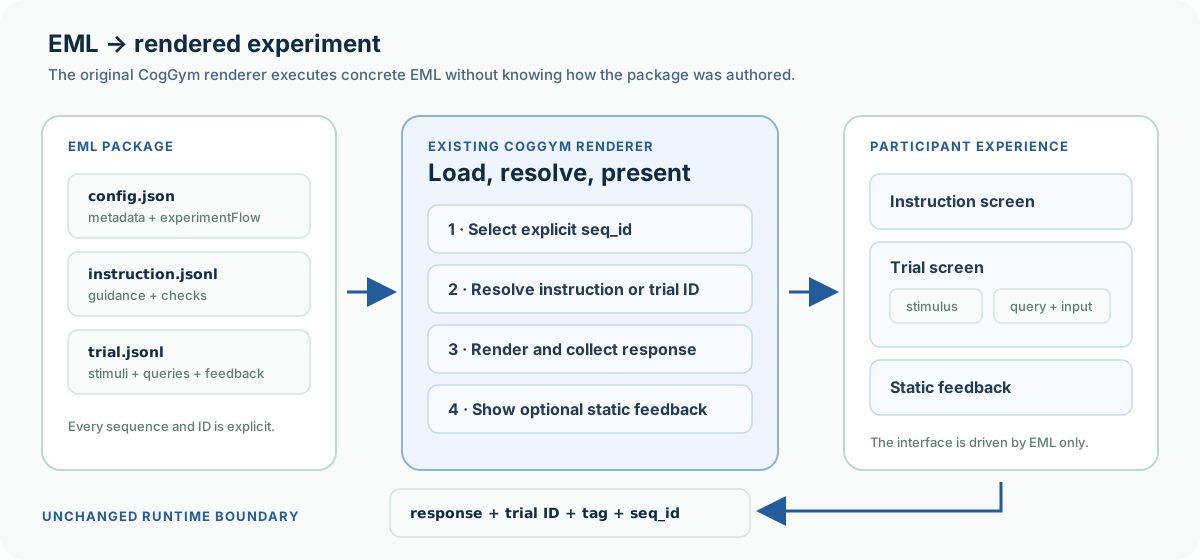
The renderer depends only on the materialized EML package, regardless of how that package was authored.
- Select a sequence. The renderer reads
config.jsonand selects an explicitseq_idfromexperimentFlow. - Resolve each component. Instruction IDs are loaded from
instruction.jsonl; trial IDs are loaded fromtrial.jsonl. - Render the interaction. The renderer presents instructions or trial stimuli, creates the specified query controls, and validates required responses.
- Complete the trial. After submission, the renderer may present the trial's feedback behavior and then advances through the explicit sequence.
- Record lineage. Responses retain the concrete trial ID, query tag, and selected sequence ID.
2.2. The EML Package
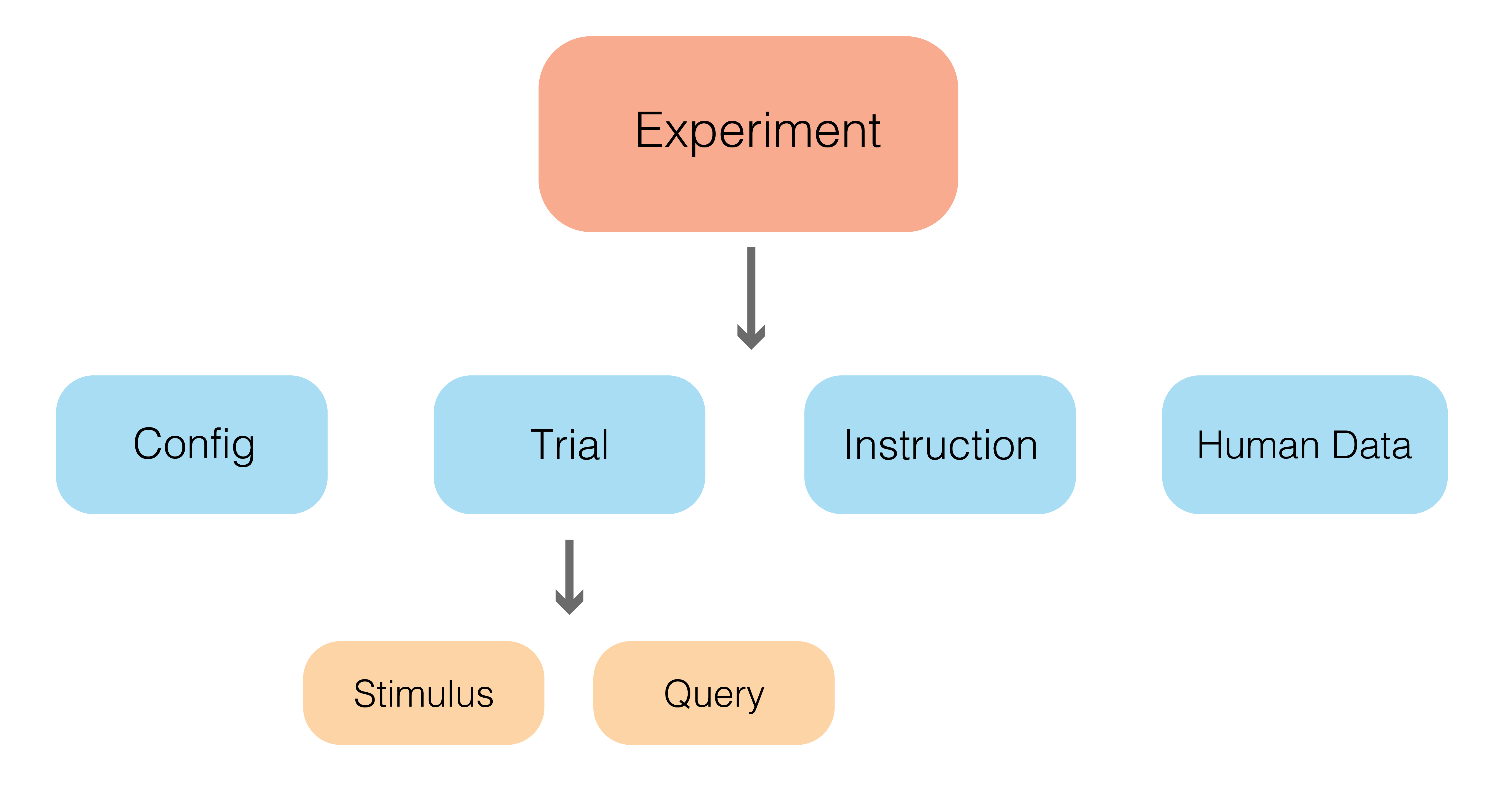
| Layer | Files | Role |
|---|---|---|
| Runtime EML | config.json, trial.jsonl, instruction.jsonl, assets/ | Defines metadata, explicit experiment flow, instructions, stimuli, queries, and optional static feedback consumed by the renderer. |
| Documentation and provenance | README.md, optional build_provenance.json | Explains the experiment and, for generated packages, records the compiler, source hashes, primitive cards, and generated IDs. |
| Data and reference outputs | Human data, ground truth, replication data, optional symbolic representations | Stores collected or reference information associated with concrete EML trial IDs and query tags; these files are not renderer inputs. |
The detailed runtime schemas are organized by responsibility:
- Config Schema — experiment metadata and explicit flow.
- Trial Schema — concrete stimuli, queries, static feedback, and trial IDs.
- Instruction Schema — instruction pages, demonstrations, and checks.
- Human Data Schema — collected responses and related reference datasets.
2.3. Directory Structure
Each dataset is contained in one root directory. A study may have multiple experiments, each in its own exp1, exp2, or subsequent subdirectory. Even a single-experiment study uses an exp1 subdirectory. The study and each experiment include a narrative README.md.
[DatasetName]/
├── README.md
├── exp1/
│   ├── README.md
│   ├── config.json
│   ├── trial.jsonl
│   ├── instruction.jsonl
│   ├── human_data_ind.json
│   ├── human_data_mean.json
│   ├── build_provenance.json      # generated packages only
│   └── assets/                    # when non-text stimuli are used
│       ├── stimulus_image_01.png
│       ├── stimulus_video_01.mp4
│       └── ...
└── exp2/                          # optional additional experiment
    ├── README.md
    ├── config.json
    ├── trial.jsonl
    └── ...
2.4. Naming Convention
The root folder name follows [AuthorLastName][Year][FirstNonArticleWordOfTitle]:
- AuthorLastName: last name of the first author.
- Year: four-digit publication year.
- FirstNonArticleWordOfTitle: first title word that is not “A,” “An,” or “The.”
For “A Minimal Theory of Mind for Social Agents” (Rabinowitz et al., 2018), the root directory is Rabinowitz2018Minimal/, containing at least exp1/.
2.5. File Inventory
Renderer inputs
config.json— required metadata and explicit experiment flow.trial.jsonl— required concrete trial definitions.instruction.jsonl— required instruction and quiz definitions.assets/— required when trials or instructions reference non-text media such as images, audio, or video.
Documentation and build records
README.md— required experiment summary and usage notes.build_provenance.json— produced by the v1.5 reference builder; records source hashes, generator version, primitive model-card identities, and generated trial and sequence IDs.
Data and reference files
human_data_ind.jsonandhuman_data_mean.json— anonymized individual and aggregated human responses.ground_truth_mean.jsonandground_truth_ind.json— optional objective answers, using the human-data key structure.human_data_mean_replication.jsonandhuman_data_ind_replication.json— optional replication responses.symbolic_representation/— optional structured world-state associated with trials or conditions.
2.6. Field-level Schema Pages
Use the following pages for field-level definitions and examples:
| Page | Defines |
|---|---|
| Config Schema | Experiment metadata, layout, conditions, sequences, blocks, and explicit component IDs. |
| Trial Schema | Trial IDs, stimuli, query controls, static feedback, and optional delay. |
| Instruction Schema | Instruction screens, examples, demonstrations, and comprehension checks. |
| Human Data Schema | Individual and aggregate response files, ground truth, and replication data. |
| Appendix | Extended examples, media details, controls, and optional symbolic representation. |